If you have a medical marijuana card and you're planning to travel, the question comes up fast: Does your card work where you're going, or do you need to sort out a whole new process before you leave?
The answer depends entirely on where you're headed. Medical marijuana card reciprocity exists in several states, but the rules vary widely. Some states let you walk into a dispensary with your out-of-state card and buy directly.
Others require you to apply for a temporary visitor card before you arrive. Some states offer no medical access at all, but have a recreational market as a backup. And a few give you no legal options whatsoever.
This guide breaks it all down so you know exactly what to expect when it comes to traveling with a medical marijuana card in hand, before you book your trip, not after you land.
What Medical Marijuana Card Reciprocity Actually Means
Reciprocity, at its simplest, means a state recognizes and honors valid medical marijuana cards or certifications issued by another state's program. But that recognition doesn't always come with the same privileges.
In some states, an out-of-state medical card gets you full purchasing access at dispensaries. In others, it protects you from possession-related legal trouble but doesn't let you buy anything locally. In others still, you can access the program, but only after completing a visitor registration before your trip.
A few things are consistent regardless of which state you're visiting:
Cannabis remains illegal under federal law. Transporting products across state lines is a federal offense, even when both states have legal programs and recognize each other's cards. This means you purchase at your destination, use what you purchase during your stay, and leave it behind when you go. There is no legal way to carry cannabis across state lines under any circumstances.
Reciprocity rules change. States pass new legislation, update their approved partner lists, launch new visitor programs, or roll back existing ones regularly. Always verify the current rules directly with the destination state's official cannabis authority before you travel.
Three Ways to Access Medical Cannabis While Traveling
Before getting into state-by-state details, it helps to understand the three main pathways travelers use to use a medical card in another state legally.
Full reciprocity with direct purchasing. Some states accept your out-of-state card at dispensaries after a simple verification process. You show your card and a government-issued ID from the same state, and you can purchase like any local patient.
Temporary visitor card programs. Other states require you to apply for a short-term license before or upon arrival. These visitor cards are typically valid for anywhere from 10 to 90 days, depending on the state. Some applications are processed quickly. Others take days or weeks, which matters if you're planning.
Adult-use recreational access. In states where recreational cannabis is legal, anyone 21 or older can purchase without a medical card at all. You lose the tax advantages and potentially the higher possession limits that medical patients get, but you do have legal access without jumping through any extra hoops.
States That Accept Out-of-State Medical Cards Directly
These states allow visiting patients to purchase at dispensaries by presenting their out-of-state medical card along with a matching government-issued ID.
Note: The state-by-state details below reflect reciprocity rules as of early 2026. State cannabis programs change frequently; always verify directly with each state’s official cannabis authority before traveling.
Delaware accepts valid out-of-state medical cards at dispensaries alongside government ID.
Louisiana serves out-of-state patients at licensed pharmacies when they present a valid medical marijuana registry card and complete a mandatory intake form.
Maine accepts cards from states on its approved reciprocity list. Show your card and ID to purchase under Maine's possession limits.
Michigan leaves the decision to individual dispensaries rather than mandating statewide reciprocity. Call ahead to verify whether a specific location accepts out-of-state patients before making the trip.
Nevada offers full reciprocity, recognizing all state medical cards, often extending medical tax rates and higher possession limits compared to adult-use purchases.
New Hampshire allows visiting patients whose qualifying condition appears on New Hampshire's approved list to purchase from Alternative Treatment Centers with a valid card.
New Mexico operates a reciprocal participant program. Patients register on-site at a dispensary using their out-of-state card and government ID, then have immediate purchasing access.
Rhode Island accepts out-of-state cards at compassion centers when you present your card alongside a government-issued ID from the same state listed on your medical certification.
Washington DC allows non-residents to either register online for a temporary patient card valid 3 to 365 days (you choose the duration) or show a valid card from a DC-approved reciprocity state directly at the point of purchase.
States That Require a Temporary Visitor Application
These states offer medical cannabis access to travelers, but you need to apply for a visitor card before showing up at a dispensary. Don't leave this until the day before you fly.
Arkansas requires an online application for a 90-day temporary card costing $50. Dispensaries cannot accept out-of-state cards directly, so arriving without pre-approval means no access.
Hawaii offers a 329V visitor card valid up to 60 days for out-of-state patients. Applications are processed online, but must be submitted in advance of travel.
Kentucky launched its medical program in January 2025 with a visiting patient option. Non-residents register for 10-day supply purchases using a valid home state card. As a newer program, verify current visitor rules before traveling.
Mississippi offers a guest patient license valid for 15 days at a time, renewable once for an additional 15 days. Applications are handled online through the state health department.
New Jersey requires visitors to apply for a 6-month Medical Cannabis Program card through a New Jersey healthcare provider, involving both practitioner approval and state registration.
Oklahoma requires an online application for a 30-day temporary license before your visit. Out-of-state patients cannot purchase at Oklahoma dispensaries without an Oklahoma-issued temporary card.
Utah offers short-term nonresident cards typically valid for 21 days. Your qualifying condition must appear on Utah's approved list, and an advance application is required before arrival.
States with Limited or Possession-Only Reciprocity
A few states offer partial protection for visiting patients without granting purchasing access.
Arizona recognizes visiting qualifying patients for possession protection, but does not allow purchases from medical dispensaries without an Arizona card. Adults 21 and older can use the recreational market instead.
Massachusetts does not accept out-of-state cards for dispensary purchases, but allows visiting medical patients to legally possess up to one ounce with a valid card. The well-established recreational market serves anyone 21 and older for purchases.
West Virginia offers extremely limited reciprocity that functionally applies only to patients with terminal cancer diagnoses. For the vast majority of medical conditions, West Virginia provides no meaningful reciprocity.
States with No Medical Reciprocity but Recreational Access
If your destination doesn't honor your medical card, a recreational market still gives you legal access if you're 21 or older, though usually at higher taxes and lower possession limits.
California, Colorado, Illinois, Maryland, Montana, New York, and Washington all fall into this category. Their medical programs are limited to residents, but active recreational markets serve visitors without any medical card requirements.
The tradeoff when using recreational dispensaries is real. Tax rates on recreational purchases typically run 5 to 15 percentage points higher than medical rates. Possession limits may be lower. Some higher-potency formulations and specialized products available in medical dispensaries don't always appear in adult-use stores.
States with No Reciprocity and No Recreational Option
These are the destinations where visiting patients have no legal cannabis access at all, regardless of card status.
Florida has no reciprocity and no recreational market. Only Florida residents or seasonal residents who hold a Florida medical card can legally access cannabis there.
Georgia operates a residents-only low-THC oil program with no reciprocity and no recreational alternative.
Pennsylvania limits its medical program to state residents and has no recreational dispensaries.
Texas offers no reciprocity for medical cards and no adult-use market.
If you’re traveling to any of these states and rely on cannabis as part of your care, plan accordingly before departure.
Federal Law: What Applies Everywhere Without Exception
Regardless of which states you're moving between, these federal restrictions don't change.
Interstate transport is a federal crime. Carrying cannabis across state lines is a federal offense that can result in serious criminal charges, including potential felony drug trafficking penalties depending on the quantity involved. The fact that both states have legal programs makes no difference. The state lines are what matter under federal law.
TSA operates under federal law. If TSA finds cannabis during security screening, they are required to refer the matter to local law enforcement. Your medical card does not prevent this from happening.
International travel is an entirely separate risk. Bringing cannabis into the United States from another country is illegal, regardless of where it was purchased or what your card says.
Federal properties remain off-limits. National parks, military bases, and federal buildings prohibit cannabis possession regardless of state laws or your medical status.
The practical rule for any trip involving cannabis: purchase after you arrive in a reciprocity state, consume during your stay, and leave it behind when you leave.
How to Prepare Before You Travel
Research the destination state directly. Use the official state cannabis control authority's website, not third-party aggregator sites that may be outdated. Reciprocity rules change frequently enough that information from a year ago can be wrong.
Apply for temporary cards early. Among all the medical marijuana reciprocity states that require advance applications, Hawaii, Oklahoma, and Arkansas are the ones that catch travelers off guard most often. These take days or weeks to process, and starting the night before departure is not a strategy that works. If your home state certification is expiring or you need a new evaluation for a visitor card, look for a service that connects you with board-certified, state-licensed physicians rather than mid-level providers; the credential difference matters when documentation crosses state lines.
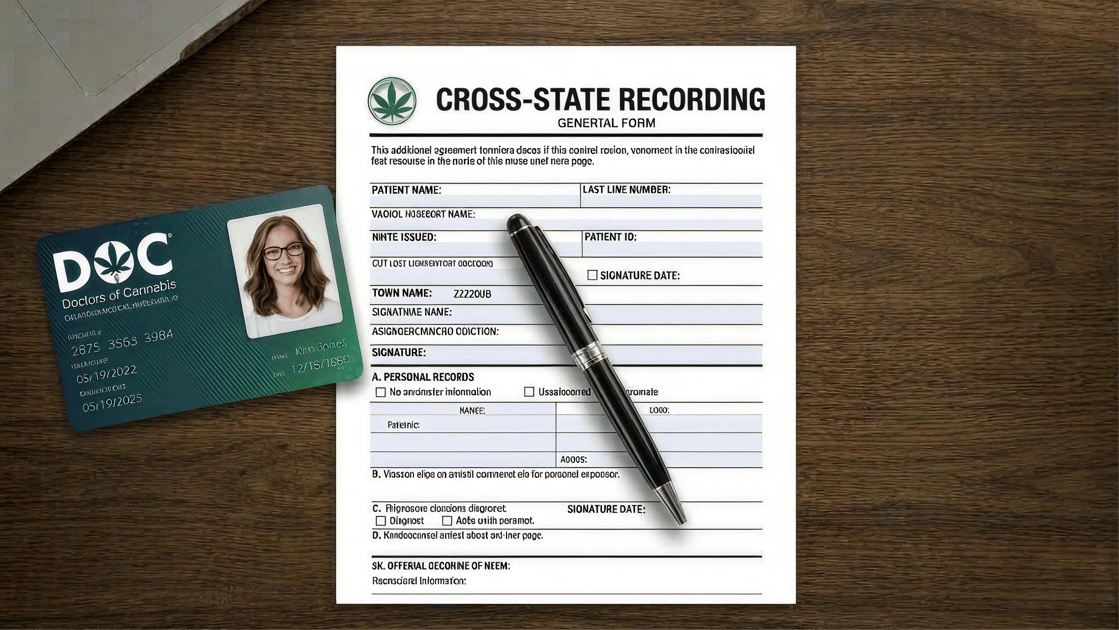
Carry both your medical card and matching government ID. Dispensaries almost universally require both, and the ID needs to be from the same state as your card.
Know your possession limits at the destination. Possession maximums for visiting patients vary by state and are sometimes different from what local patients are allowed. Staying within those limits is your responsibility.
Download the documentation to your phone. Keep digital copies of your medical card, any visitor approval letters, and your government ID somewhere accessible. Physical copies get lost.
Plan where you'll consume. Most states prohibit cannabis use in public spaces. Know whether your accommodation allows it or whether you'll need to make other arrangements.
If You're Denied Access Despite Reciprocity
It happens occasionally. Here's what to check if a dispensary won't serve you despite believing you're in a reciprocity state.
First, confirm that your qualifying condition appears on the destination state's approved list. Some reciprocity programs only accept visitors whose conditions match their own qualifying requirements, not all conditions recognized in your home state.
Second, verify the type of documentation you have. Many states require a state-issued registry card rather than a physician recommendation letter or certification document alone.
Third, check that your card hasn't expired. Reciprocity applies to valid, current cards only.
Fourth, confirm that the names and addresses on your card and your ID match and that neither has obvious discrepancies.
If medical access still isn't available, check whether the state has a recreational market you can use as an alternative while sorting out the issue.
What Doctors of Cannabis Offers Traveling Patients
Doctors of Cannabis connects patients with board-certified, state-licensed physicians who take an education-first approach to every evaluation. That means the physician doesn’t just verify your condition; they take time to explain how cannabinoids may relate to your qualifying condition, which delivery methods patients in your situation commonly consider, how to think about usage, and what realistic expectations look like.
Physicians in the Doctors of Cannabis network also review your current medications to identify any potential interactions worth discussing with your care team.
Through our telehealth partner network, patients can complete their evaluation by phone or secure video, whichever works best. Select your state, book your appointment, and speak with a licensed physician at your scheduled time. If you qualify, you’ll receive your certification and guidance on any state registration steps specific to your program.
Transparent pricing, no surprise fees, and you only pay if approved. Your card is validated at registration, but never charged unless the physician certifies you.
For patients who need help navigating a temporary visitor card application or unfamiliar state registration process, Doctors of Cannabis also offers an application assistance program through a dedicated network of experienced cannabis nurses.
Doctors of Cannabis connects patients to licensed physicians through our telehealth partner network. You only pay if approved.
The Bottom Line
Ready to get started? Book your appointment with Doctors of Cannabis today and speak with a physician who will actually explain your options.