

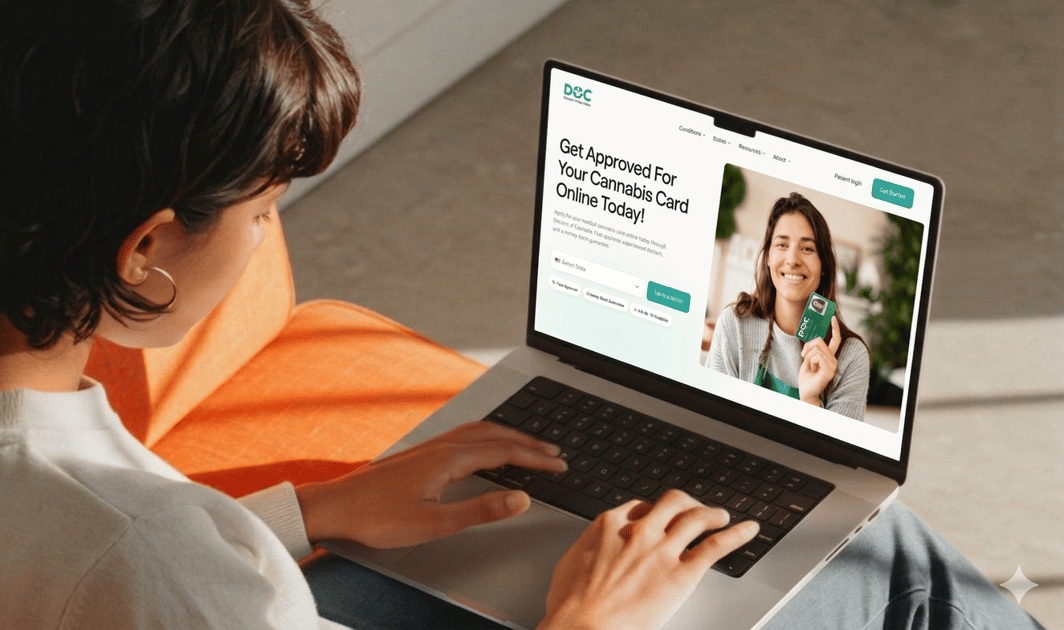
Getting a medical marijuana card online should take 30 minutes. Not 3 hours of research trying to figure out which service is legitimate, which one will actually show up for your appointment, and which one will quietly pocket your money if something goes wrong.
This guide cuts through the noise. We're covering how these services work, what separates the good from the frustrating, and how to get a medical card online without getting burned.
What Online Medical Marijuana Card Services Actually Do
Before comparing any providers, it helps to understand what you’re paying for and what you’re not.
These services connect you with a licensed doctor for a telemedicine evaluation. The doctor reviews your medical history, asks questions, and decides whether to certify you. If approved, you will receive a certification document. That's the core of any online mmj card service.
What they handle:
- Video consultation scheduling
- Verifying that doctors are licensed in your state
- Delivering your certification documents
- Basic guidance on state registration steps
What they don’t handle:
- Paying your state fees
- Guaranteeing card approval
- Providing ongoing medical care
Note: Some providers, including Doctors of Cannabis through its application assistance partner program, do offer help submitting your state application. Most, however, leave this step entirely to you. Ask before you assume.
Here’s the part that trips up a lot of first-time patients. There are always two steps and two separate payments. You pay for your doctor’s evaluation. Then you pay your state health department to register and receive your actual card. No national provider can skip this second step, no matter what their marketing suggests.
Why People Choose to Get a Medical Card Online
The shift toward telemedicine medical marijuana card services isn't surprising when you look at the alternatives.
Convenience tops the list for most people. You can complete your evaluation from home, without driving to a clinic, waiting in a waiting room, or taking time off work.
Speed is the next big factor. Most online services deliver certifications within 24 to 48 hours. In-person clinics often take weeks.
Accessibility matters enormously for patients dealing with chronic pain, mobility limitations, or living far from licensed providers. For many, telemedicine isn’t just convenient, it’s a practical option.
Privacy is something people don’t always talk about openly, but it matters. Walking into a physical marijuana clinic in a small town is a different experience from having a private video call at home.
Cost also works in favor of online services. Based on our review of major providers as of February 2026, online evaluations typically range from $35 to $200, compared to $150 to $300 or more for in-person visits at physical clinics.
How to Evaluate the Best Online Medical Marijuana Card Services
Not every service that shows up in a search result deserves your money. Here’s what to actually look at before booking.
Price Transparency
The advertised price should match what you pay at checkout. Watch for processing fees, rush fees, or membership costs that appear late in the process. A good service lists its final price clearly, per state, before you enter any payment details.
Appointment Reliability
This is where many services fall apart. Check recent reviews, not just testimonials on their own website, but feedback on Google, Trustpilot, and Reddit from the last 3-6 months. Pay attention to patterns like missed appointments, repeated technical issues during calls, or unexplained delays.
Refund Policy Clarity
The best medical marijuana card websites offer a simple policy: if you're not approved, you pay nothing. No processing-fee deductions, no store-credit workarounds, no complicated conditions buried in the terms.
Support Responsiveness
When something goes wrong, you want to reach an actual person quickly. Multiple contact methods, fast response times, and real problem-solving matter. Automated email replies that take three days tell you everything you need to know.
Licensing Verification
Your doctor should be licensed in your specific state, not simply labeled a “healthcare professional.” Vague credentials are a red flag. Some services connect you with nurse practitioners or physician assistants instead of physicians, so if a physician-level evaluation matters to you, confirm the provider type before booking.
What Happens During the Evaluation
This is something most comparison sites skip entirely, but it matters. A cannabis evaluation isn’t supposed to be a rubber stamp; it’s a medical consultation. The physician should review your medical history, ask about current medications, discuss how different cannabinoid options relate to your qualifying condition, and flag any potential drug interactions worth raising with your primary care provider.
Some services complete this process in under 5 minutes. Others build in enough time for the physician to actually educate you, covering delivery methods, dosing considerations, and what to expect as a new patient.
The difference isn’t just about thoroughness. Patients who leave their evaluation with a clear understanding of their options tend to have better outcomes at the dispensary and fewer issues with their ongoing care.
When comparing services, ask what the consultation actually includes. If the answer is “the doctor reviews your form and approves you,” that tells you something about how much the service values the clinical relationship versus the transaction.
State Application Assistance
Here’s something most patients don’t realize until after their evaluation: getting certified by a physician is only the first step. You still need to complete a separate application through your state’s health department or cannabis authority, and for many patients, that 2nd step is where things go wrong. State portals can be confusing.
Requirements differ from state to state.
Some need specific photo dimensions, others require notarized documents or witness signatures, and most have processing timelines that catch first-time applicants off guard. Rejected applications mean resubmission delays of two to four weeks in some states, sometimes with additional fees.
Most online certification services stop at the physician evaluation and leave the state application entirely to you. A smaller number offer dedicated application support, helping with portal navigation, document uploads, and submission tracking.
If you’re not confident navigating your state’s registration system on your own, this is worth asking about before you choose a provider. It can be the difference between having your card in 2 weeks and spending a month fixing rejected paperwork.
Best Medical Marijuana Card Websites Compared
Disclosure: Doctors of Cannabis publishes this guide and is included in this comparison. We encourage patients to evaluate all providers based on the criteria outlined above.
Here’s a quick breakdown of the main providers currently operating across the US.
Trusted by thousands of patients, rated around 4.6★ across hundreds of reviews, and BBB accredited. Doctors of Cannabis stands out for patients who want more than just a quick signature.
Doctors of Cannabis connects you with an independent, board-certified physician through a telehealth partner network for an education-first evaluation that actually covers what matters: your qualifying condition, delivery methods, dosing guidance, and potential medication interactions with your current prescriptions.
Application assistance is handled through a partner network that manages state portal submission, document uploads, and progress tracking, so you're not left figuring out the paperwork alone. Transparent pricing, no surprise fees, and you only pay if approved.
Quick Med Cards offers a strong overall balance of reliability, speed, and support quality. Their price beat guarantee takes cost off the table as a deciding factor, which is useful if you're comparing multiple providers and don't want to second-guess whether you're overpaying.
A solid choice for patients who want dependable service without a lot of friction in the process.

NuggMD is one of the faster options on this list and operates across 31 states with a clean, modern interface. Where it falls short is in support. When issues come up, patients report difficulty reaching someone who can actually resolve the problem.
If your evaluation goes smoothly, NuggMD works well. If something goes sideways, getting help can be frustrating. Best for patients who prioritize speed and are comfortable handling things independently if a problem arises.

Leafwell holds a 4.7 out of 5 rating on Trustpilot based on over 8,500 reviews as of February 2026. Approximately 3% of reviewers report problems with delayed certifications or renewal processing, which is worth keeping in mind if your timeline is tight.
The platform doesn't emphasize physician credentials or education-focused consultations in its marketing, so if clinical guidance matters to you, it's worth asking what the evaluation actually includes before booking.
Best for budget-conscious patients in select states who are comfortable with a higher-volume platform.

Green Health Docs takes a hybrid approach, offering both telemedicine and physical clinic options for patients who want the flexibility of an in-person visit if needed. Support quality is solid, and medical guidance is generally thorough. The tradeoff is price.
This is one of the more expensive options on the list, so the added flexibility comes at a cost. Best for patients who want an in-person backup option or who have more complex medical situations that benefit from face-to-face care.

Veriheal currently holds a 3.2 out of 5 rating on Trustpilot based on over 1,100 reviews as of February 2026, lower than most competitors on this list. Approximately 6% of reviews are one-star, with recurring themes around renewal processing issues and pricing concerns.
The company does respond to negative reviews publicly, which counts for something, but the pattern is consistent enough to flag. If you're considering Veriheal, check their most recent Trustpilot feedback before committing.
Best for first-time patients comfortable with a larger platform and who go in with realistic expectations.

What Separates Good Services from Frustrating Ones
When you look at what patients consistently complain about, a pattern emerges. The problems aren’t usually about cannabis or medical decisions. They’re about basic service execution.
The Common Problems
Ghost appointments. The doctor doesn’t show for your scheduled consultation. No explanation. No proactive rescheduling. You’re left waiting and have to chase support to find out what happened.
Hidden fees. The checkout total jumps $30 to $50 above the price you saw advertised. Processing charges, rush fees, or mandatory membership costs appear at the last step.
Refund runarounds. You’re not approved and request your refund, but the service finds reasons to deny it, deduct from it, or offer credit instead of actual money back.
Missing certifications. Days pass after your approval, and no certification document arrives. Support gives vague “processing” responses without a real timeline.
State registration confusion. Some services provide minimal guidance on what comes next, leaving patients to figure out the state application process on their own, sometimes with outdated or incorrect instructions.
Auto-renewal surprises. A charge appears on your card for a renewal you didn’t knowingly authorize.
What the Good Ones Do Differently
The services that earn patient trust consistently do a few things well. They explain the two-step process upfront without burying the second payment in fine print.
Doctors show up on time. Support is reachable by chat or phone, not just email. And when something goes wrong, they fix it within hours, not days.
Understanding State Registration: What Comes After Your Evaluation
Once your doctor approves your certification, your work isn’t done. You’ll need to complete a separate application through your state health department. Here’s what that looks like in practice and why this step trips up more patients than the evaluation itself.
Qualifying conditions vary by state; what qualifies you in one state may not qualify in another. Always check your state’s current list of qualifying conditions before scheduling an evaluation.
State fees vary widely. New Jersey, Ohio, and New Mexico charge nothing for state registration. Arizona can run over $150. Most states land somewhere in the $25 to $75 range.
Processing time is typically 5 to 14 days for most states, with expedited options available in some locations for an additional fee.
You’ll need to have ready:
- A valid ID proving state residency
- Your certification from a licensed doctor
- Completed state application forms
- Proof of your qualifying condition (requirements vary by state)
What you receive also varies. Some states mail a physical card. Others use digital IDs. A few provide a printable temporary certification immediately after approval.
Where the State Application Process Gets Complicated
The state application sounds straightforward on paper. In practice, it’s the step that generates the most frustration, particularly for first-time applicants, older patients, or anyone unfamiliar with government health portals.
Common issues include photo uploads that get rejected for wrong dimensions or file size, residency documentation that doesn’t match what a specific state accepts, and form fields that use terminology patients haven’t encountered before. Some states require additional steps like witness signatures, caregiver designations, or veteran exemption documentation that aren’t obvious from the main application page.
When an application is rejected, the resubmission timeline can add 2-4 weeks, and in some states, the patient pays again to resubmit. For patients dealing with chronic pain or other qualifying conditions, that delay isn’t just an inconvenience.
This is why application assistance has become a meaningful differentiator among online certification services. Providers that help patients navigate the state portal, format documents correctly, and track submission status eliminate the most common reason patients lose time between their evaluation and actually receiving their card.
Total first-year cost for most patients: Based on our review of major providers as of February 2026, combining the service fee and state registration, expect to pay between $100 and $300, depending on your state and the provider you choose. Renewals typically cost 30 to 50 percent less.
How to Get Your Medical Card Online Safely: Best Practices
A little preparation before your appointment makes the whole process smoother.
- Gather your medical history before the call. Bring diagnosis records, prescription history, and documentation of previous treatments.
- Test your technology ahead of time. Make sure your video call works on your device, check your internet connection, and have a backup contact method ready.
- Ask specific questions during the consultation. Usage guidance, product types, drug interactions, and renewal timelines are all worth raising with your physician.
- Download your certification immediately after approval. Keep confirmation emails and any state registration instructions somewhere easy to find.
- Submit your state application promptly. Some certifications have an expiration window for registration.
- Set a renewal reminder. Most certifications last 7 to 12 months. Missing the window means losing dispensary access until you renew.
Red Flags That Should Make You Walk Away
Some promises are easy to spot once you know what to look for.
- Guaranteed approval claims. No legitimate service can guarantee approval. Doctors make independent medical decisions based on your specific situation.
- “Instant card” language. Your state processes and issues the physical or digital card. Anyone claiming otherwise is not being straight with you.
- No real consultation required. A legitimate telemedicine medical marijuana card evaluation requires a live video call with a licensed doctor. Email questionnaires do not qualify.
- Vague licensing language. If the website talks about “medical professionals” without confirming state-licensed physician credentials, keep looking.
- Countdown timers and “limited slots today” pressure. This is a sales tactic, not a real supply issue.
- Suspiciously perfect reviews. Every real service has some negative feedback. If every review is five stars across every platform, something has been filtered or fabricated.
Alternative Options Worth Knowing About
Online services work well for most people, but they’re not the right fit for every situation.
Local in-person clinics make more sense for complex medical situations that need a thorough examination, or for patients who aren’t comfortable with video calls.
Your primary care doctor is worth asking if you have an established relationship. Some regular physicians offer cannabis certifications, and the continuity of care is a genuine advantage.
Community health centers often charge lower fees for low-income patients and may include additional medical services alongside the evaluation.
State-specific telehealth programs exist in some states with their own provider partnerships offering reduced rates.
How Doctors of Cannabis Handle This Differently
Doctors of Cannabis connects you with an independent, board-certified physician through our telehealth partner network for a thorough, education-first evaluation. That means you don’t just get a yes or no; your physician takes time to discuss how cannabis may relate to your qualifying condition, common delivery methods, usage considerations, and what to discuss with your ongoing care team.
Your physician will also review your current medications to identify any potential interactions worth discussing with your primary provider.
For patients who want help beyond the evaluation, Doctors of Cannabis also offers an application assistance program through a dedicated partner network of experienced US-based cannabis nurses.
They handle the state portal submission form completion, document uploads, and status tracking. It means that you’re not navigating a government website on your own after your appointment. It’s available as a standalone service or bundled with the physician evaluation.
Select your state, book your appointment, and speak with a licensed physician by phone or secure video from any device. If you qualify, you’ll receive your certification and guidance on your state’s registration process. Transparent pricing, no surprise fees, and you only pay if approved.
If your physician determines you don’t qualify, you pay nothing.
If you’ve been exploring whether medical cannabis may be right for your qualifying condition, finding out if you qualify through a licensed physician evaluation is a logical next step.
Doctors of Cannabis connects patients to licensed physicians through our telehealth partner network. You only pay if approved.
Book Your Evaluation with Doctors of Cannabis
The Bottom Line
When you're ready to get a medical card online, the best service is the one that treats you like a patient, not a transaction. If you want a physician who will actually discuss your options rather than just process paperwork, start with Doctors of Cannabis.
Doctors of Cannabis connects patients to licensed physicians through our telehealth partner network. You only pay if approved.

Cannabis Use Disorder: What You Need to Know
Cannabis is widely seen as low-risk, especially as legalization expands, but...


What Are the Different Ways to Consume Cannabis?
Walk into any dispensary, and the number of product formats can be...

Can You Use Cannabis for Diarrhea?
Diarrhea affects people of all ages, and for those dealing with it as a chronic...
Need more clarity on the process?
Our team can help you understand the steps to get a medical cannabis card in your state.